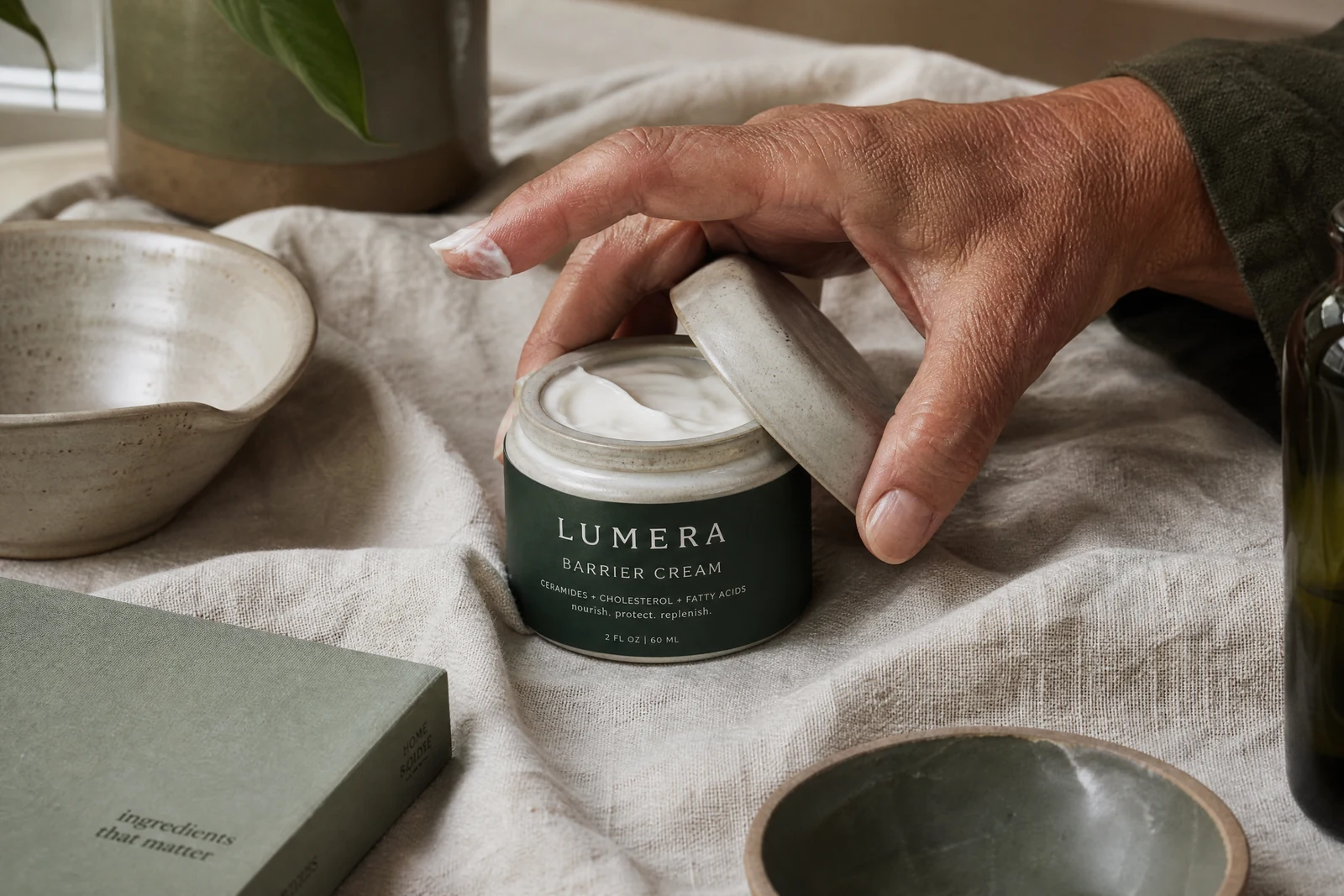
Ceramides are lipids naturally found in the outermost skin layer. Together with cholesterol and fatty acids, they help organize the barrier that limits water loss and reduces entry of irritants. Dry or inflamed skin can have an altered lipid profile, which is why ceramides appear in many barrier-focused moisturizers.
What a topical ceramide product can do
A good moisturizer can reduce tightness, flaking and water loss. Ceramides may help replenish part of the lipid structure, but the product still needs an effective vehicle. Humectants draw in water, emollients smooth gaps and occlusives slow evaporation.
The ingredient list may use names such as Ceramide NP, AP or EOP. A long ceramide list is not proof of ideal ratios or delivery. Published research often evaluates a complete formula, not an isolated ingredient label.
When to use one
Ceramide moisturizers are useful in simple dry-skin routines and as support when starting retinoids or exfoliants. Apply after water-based serums and before sunscreen in the morning. At night, a richer layer may help if indoor heating, air conditioning or treatment products increase dryness.
If skin is very reactive, prioritize fragrance-free formulas with a shorter ingredient list. Patch testing is still sensible because preservatives, botanicals and other ingredients can cause reactions even when ceramides themselves are well tolerated.
What they cannot solve alone
Persistent cracking, oozing, severe itch or widespread inflammation may need medical care. A ceramide cream is supportive skincare, not a diagnosis or a substitute for prescribed treatment.
For routine shopping, choose by texture, tolerance, price per use and the complete moisturizing system. The word ceramide on the front label is only the beginning of the evaluation.
PRACTICAL NEXT STEP
Test an ingredient in its real formula
An ingredient is only one part of a finished product. Format, concentration, supporting ingredients and how often you use it all affect the experience. Treat the guide as a way to frame a test, not as a promise about a single word on a label.
Use this article to guide: moisturizer, dryness, sensitivity.
- Choose one product role, such as a treatment, moisturizer or cleanser.
- Introduce one new formula at a time and follow its directions.
- Note comfort, texture and visible changes before deciding whether to continue.
Before making a purchase or adding another step, decide what this change would replace. A smaller, clearer test is easier to evaluate than several new products used at once.
Revisit the decision after a few ordinary uses. Keep what is genuinely useful, simplify what is not, and let comfort and practicality carry more weight than a trend or a single swatch.
Keep the limit clear: A label cannot diagnose a skin condition or predict every reaction. Repeated irritation is a reason to stop, not to add more actives.
EXPLORE THE CONTEXT
Continue through the beauty archive.
Take the next useful route rather than treating one article as the end of the question.
Sources
Last reviewed Jan 10, 2025. This article is educational and does not replace medical advice.