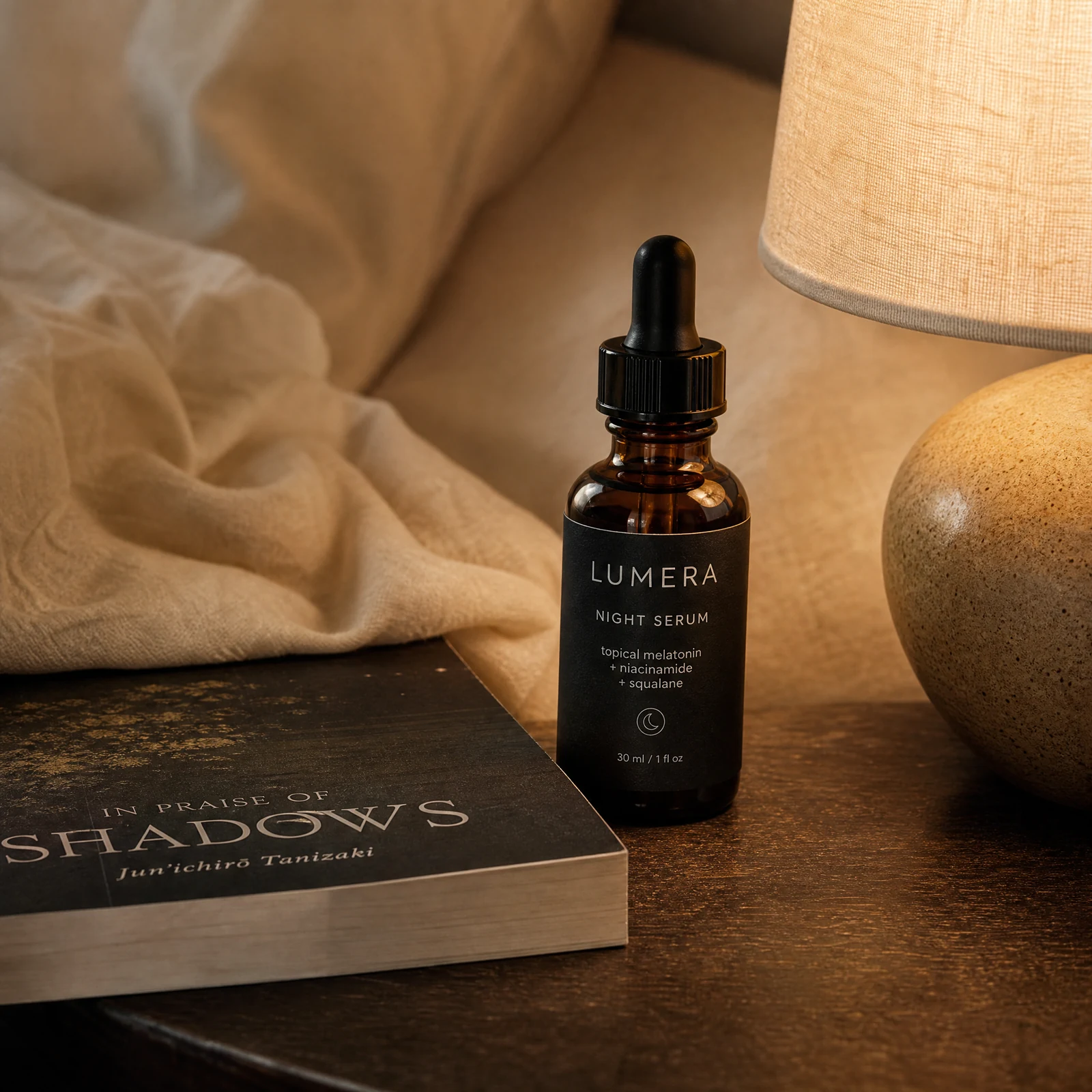
Melatonin is best known as a hormone involved in sleep timing, but it also appears in skincare as an antioxidant ingredient. A topical formula is not a sleep aid: applying a serum with melatonin does not mean it will make you sleepy or replace any medical use of melatonin.
The more useful question is whether it earns a place beside better-known antioxidants. The short answer is that the biology is interesting, while the finished-product evidence is still limited.
What topical melatonin may contribute
Melatonin can participate in antioxidant pathways, which is why brands often position it around overnight recovery and visible signs of environmental stress. Laboratory and small clinical studies give researchers reason to keep investigating it. They do not establish that every melatonin serum improves wrinkles, pigmentation or skin quality in the way its marketing may imply.
That distinction matters. An ingredient can be plausible without being the part of a formula responsible for every claimed result. Vehicle, concentration, packaging, accompanying ingredients and how consistently the product is used all change the real-world experience.
What it cannot replace
Melatonin does not replace broad-spectrum sunscreen, a proven retinoid strategy or a moisturizer that keeps the skin comfortable. It is also not a substitute for assessment of a changing lesion, persistent rash or significant pigment concern.
Be wary of copy that turns “antioxidant” into “repairs all sun damage.” Daily protection limits new ultraviolet exposure; an evening product can only support the routine that follows it.
Where it can fit
A melatonin product most often makes sense as an evening serum or moisturizer. Start with the directions on the specific formula, especially when it also contains retinoids, exfoliating acids, vitamin C or fragrant oils.
For a cautious introduction:
- Apply it on a night when the rest of the routine is simple.
- Use it two or three times a week first if your skin is reactive.
- Add a plain moisturizer if the formula does not provide enough comfort.
- Keep sunscreen as the final step every morning.
If a formula stings, creates a rash or leaves the skin persistently dry, stop using it. That reaction may come from the full formula rather than melatonin alone, but comfort is still the deciding signal.
How to evaluate a product claim
Look for clear information about the product format and supporting ingredients rather than relying on an “overnight” label. An oil-rich serum may suit dry skin but feel heavy for someone who prefers a light gel. A formula paired with a retinoid may require slower pacing than a simple antioxidant moisturizer.
The best conclusion is modest: topical melatonin is a reasonable supporting antioxidant to explore when the formula otherwise fits your skin and routine. It should not be the sole reason to expect a dramatic change.
PRACTICAL NEXT STEP
Test an ingredient in its real formula
An ingredient is only one part of a finished product. Format, concentration, supporting ingredients and how often you use it all affect the experience. Treat the guide as a way to frame a test, not as a promise about a single word on a label.
Use this article to guide: night serum, moisturizer, photoaging.
- Choose one product role, such as a treatment, moisturizer or cleanser.
- Introduce one new formula at a time and follow its directions.
- Note comfort, texture and visible changes before deciding whether to continue.
Before making a purchase or adding another step, decide what this change would replace. A smaller, clearer test is easier to evaluate than several new products used at once.
Revisit the decision after a few ordinary uses. Keep what is genuinely useful, simplify what is not, and let comfort and practicality carry more weight than a trend or a single swatch.
Keep the limit clear: A label cannot diagnose a skin condition or predict every reaction. Repeated irritation is a reason to stop, not to add more actives.
EXPLORE THE CONTEXT
Continue through the beauty archive.
Take the next useful route rather than treating one article as the end of the question.
Sources
- PubMed search - topical melatonin and skin
- National Center for Complementary and Integrative Health - Melatonin
Last reviewed Dec 5, 2025. This article is educational and does not replace medical advice.