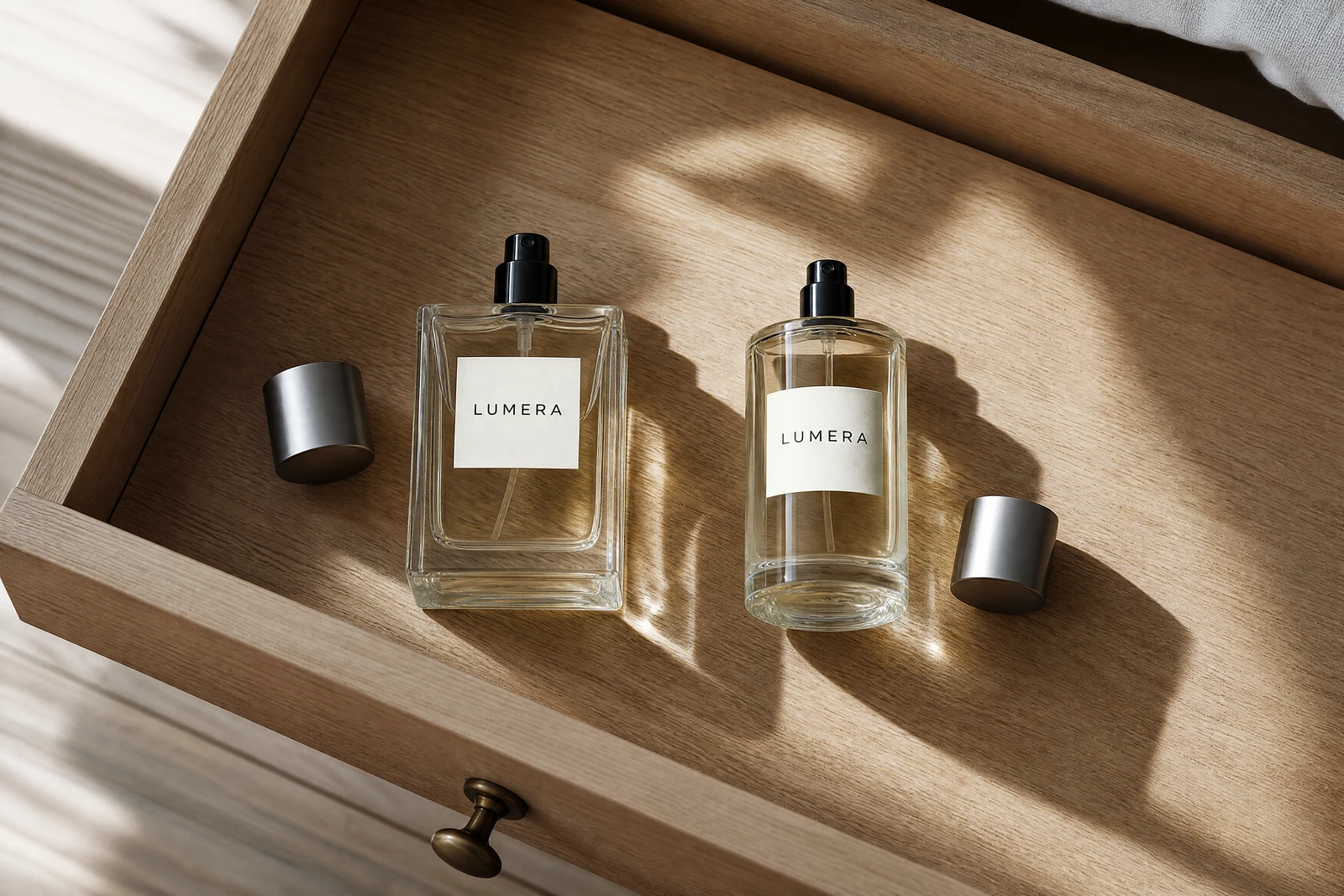
Fragrance does not need a special display case to be treated well. It does benefit from being kept away from the parts of a home that change temperature and light most dramatically. The simplest useful approach is to store bottles upright in a cool, dry cabinet or drawer and keep the cap on when they are not in use.
Choose consistency over display
Bathroom shelves and sunny windowsills can be convenient, but they also expose a bottle to changing humidity, heat and direct light. A dresser drawer or closed cabinet is usually easier on a fragrance and easier to keep consistent. Keep the original box when it is practical, especially for a bottle you use only occasionally.
Do not turn this into a rule against using what you own. A favorite bottle belongs where you will reach for it. The point is to avoid leaving it in the harshest conditions day after day.
Keep the bottle simple
Close the cap, avoid repeatedly decanting a fragrance into decorative containers and keep bottles upright to reduce preventable mess. If the color, scent or texture changes markedly, pause before using it on sensitive skin. Product labels can provide useful handling information; they cannot make a bottle impervious to poor storage.
Buy in a size you can enjoy
For a scent you are still learning, a smaller size can be more useful than a large bottle stored for years. Sampling, wearing it in different settings and choosing a size you can realistically finish makes fragrance feel less like an object to preserve and more like something to use.
PRACTICAL NEXT STEP
Wear fragrance in context
A fragrance is part of a shared environment as well as a personal preference. The best test is a light application on a normal day, with time to notice how it develops and how it feels on the skin.
Use this article to guide: eau de parfum, eau de toilette, scent preference.
- Start with one scent or one clear pairing instead of several competing products.
- Give the dry-down time before deciding whether a bottle suits you.
- Store bottles upright, capped and away from sustained heat and direct light.
Before making a purchase or adding another step, decide what this change would replace. A smaller, clearer test is easier to evaluate than several new products used at once.
Revisit the decision after a few ordinary uses. Keep what is genuinely useful, simplify what is not, and let comfort and practicality carry more weight than a trend or a single swatch.
Keep the limit clear: Do not apply fragrance over irritated skin. A lighter application is usually the more considerate choice in close or shared spaces.
EXPLORE THE CONTEXT
Continue through the beauty archive.
Take the next useful route rather than treating one article as the end of the question.
Sources
Last reviewed Apr 18, 2025. This article is educational and does not replace medical advice.