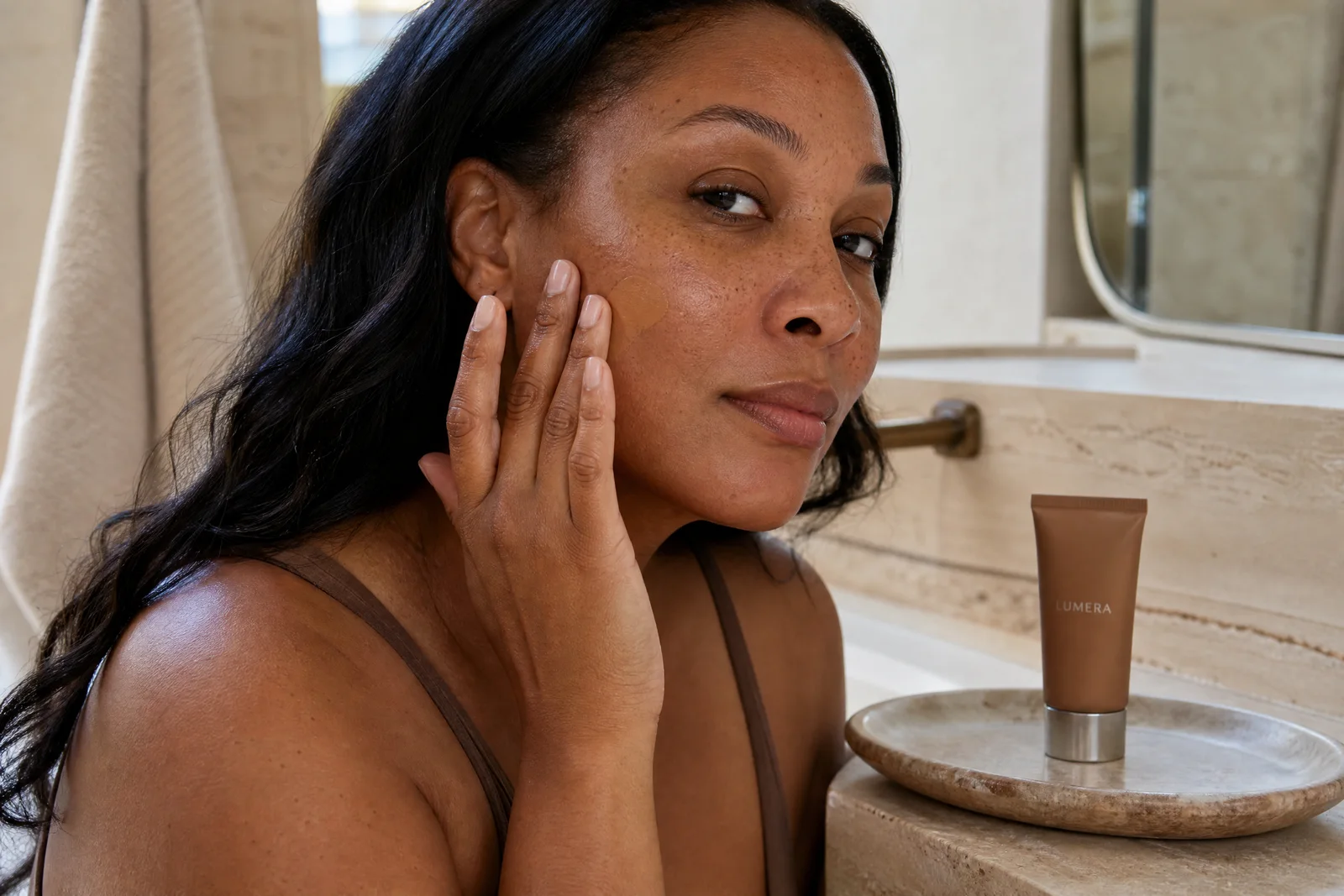
Complexion makeup is easier to use when it is treated as adjustment rather than correction. The aim can be a little more evenness, a little more warmth or a finish that helps the rest of a look feel intentional. It does not need to erase every natural change in the skin.
Start with the job, not the label
Ask what you want the product to do on an ordinary day. A skin tint can soften contrast while leaving freckles and texture visible. A foundation usually gives more pigment and a more uniform result. A concealer is useful when there are only a few areas you want to address.
Coverage language is not standardized across every brand, so a “medium” formula can feel very different from one product to the next. Begin with a small amount in the center of the face, then look at the result in daylight before deciding whether another pass is useful.
Match undertone before chasing perfection
Shade depth is only one part of a match. The underlying cast can read pink, golden, neutral, olive or a mix that shifts through the year. Test a small stripe where the face meets the neck and let it sit long enough to dry down. A formula that disappears at that transition is usually a better starting point than one that only looks convincing on the hand.
If a perfect match is unavailable, choose the formula that is closest in undertone and use a sheer application. A concentrated product can be adjusted with a small amount of moisturizer or mixed with a neighboring shade, provided the texture stays comfortable.
Build in thin passes
Press or sweep on one light layer, then pause. Most heavy-looking base makeup comes from adding more before the first layer has settled. A small brush can offer precision around the nose; fingertips can keep a sheer formula connected to the skin; a sponge can soften an edge without adding much product.
Remove the product as carefully as you apply it, especially around the eyes and hairline. If a cosmetic repeatedly stings, burns or causes a persistent reaction, stop using it and consider speaking with a qualified clinician.
PRACTICAL NEXT STEP
Keep the technique proportionate
Color cosmetics are easier to enjoy when the product has one assignment. A small adjustment to coverage, color or hold often looks more intentional than trying to correct every detail at once.
Use this article to guide: skin tint, foundation, concealer.
- Apply the thinnest useful layer, then step back before adding more.
- Check shade and texture in daylight as well as under indoor light.
- Clean tools regularly and stop using a product that repeatedly causes discomfort.
Before making a purchase or adding another step, decide what this change would replace. A smaller, clearer test is easier to evaluate than several new products used at once.
Revisit the decision after a few ordinary uses. Keep what is genuinely useful, simplify what is not, and let comfort and practicality carry more weight than a trend or a single swatch.
Keep the limit clear: A cosmetic can change a finish, not diagnose or treat a skin concern. Keep products out of the eyes and follow the label directions.
EXPLORE THE CONTEXT
Continue through the beauty archive.
Take the next useful route rather than treating one article as the end of the question.
Sources
Last reviewed Jul 3, 2026. This article is educational and does not replace medical advice.