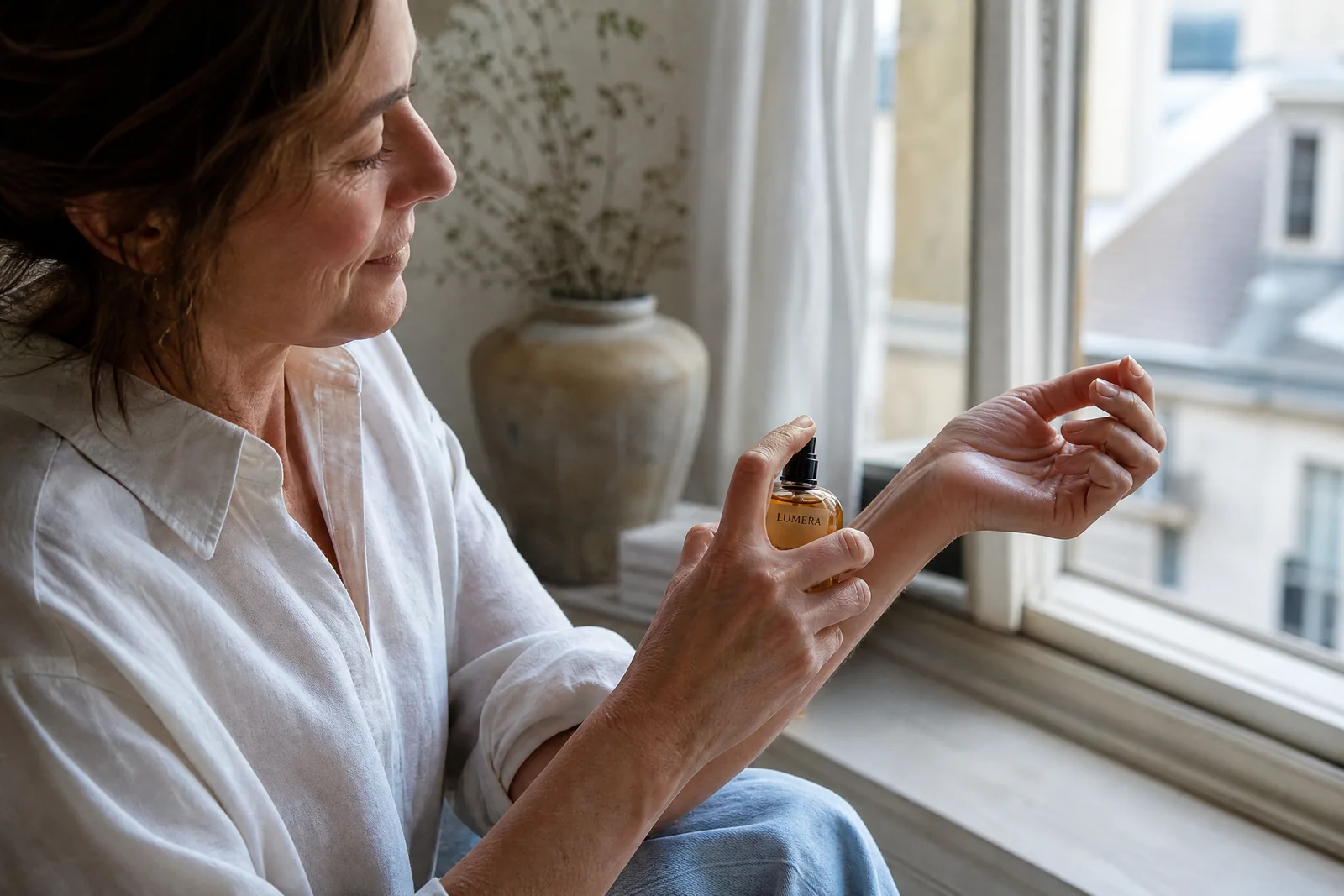
Layering fragrance is less about creating a completely new perfume than about deciding what you want to hear more clearly. A soft musk can make a bright citrus feel rounder. A woody scent can give a floral a quieter base. The easiest way to learn is to begin with two products, not a crowded sequence.
Choose one anchor
Start with the scent you already enjoy on its own. That is the anchor. Add a second product only when it has a simple relationship to the first: a clean skin scent beneath a green floral, a gentle vanilla beneath a dry wood or an unscented lotion that changes only the feel of application.
Apply the anchor first, then use a small amount of the supporting scent on a different point. This makes it easier to tell whether the combination is working instead of creating one indistinct cloud.
Give it time before adding more
Fragrance shifts after application. Wait until the first scent has settled before deciding it needs another layer. If the blend becomes confusing, return to one product and try a different pairing another day.
The setting matters as much as the formula. A combination that feels welcome outdoors may feel too present in a small office, a shared car or a restaurant.
Keep the routine comfortable
Do not layer directly over irritated skin. If you use scented body care and a perfume, be especially mindful of how many fragranced products are touching the same area. A lighter application is often the more considerate choice for both your skin and people nearby.
PRACTICAL NEXT STEP
Wear fragrance in context
A fragrance is part of a shared environment as well as a personal preference. The best test is a light application on a normal day, with time to notice how it develops and how it feels on the skin.
Use this article to guide: eau de parfum, body lotion, fragrance oil.
- Start with one scent or one clear pairing instead of several competing products.
- Give the dry-down time before deciding whether a bottle suits you.
- Store bottles upright, capped and away from sustained heat and direct light.
Before making a purchase or adding another step, decide what this change would replace. A smaller, clearer test is easier to evaluate than several new products used at once.
Revisit the decision after a few ordinary uses. Keep what is genuinely useful, simplify what is not, and let comfort and practicality carry more weight than a trend or a single swatch.
Keep the limit clear: Do not apply fragrance over irritated skin. A lighter application is usually the more considerate choice in close or shared spaces.
EXPLORE THE CONTEXT
Continue through the beauty archive.
Take the next useful route rather than treating one article as the end of the question.
Sources
Last reviewed Nov 21, 2025. This article is educational and does not replace medical advice.