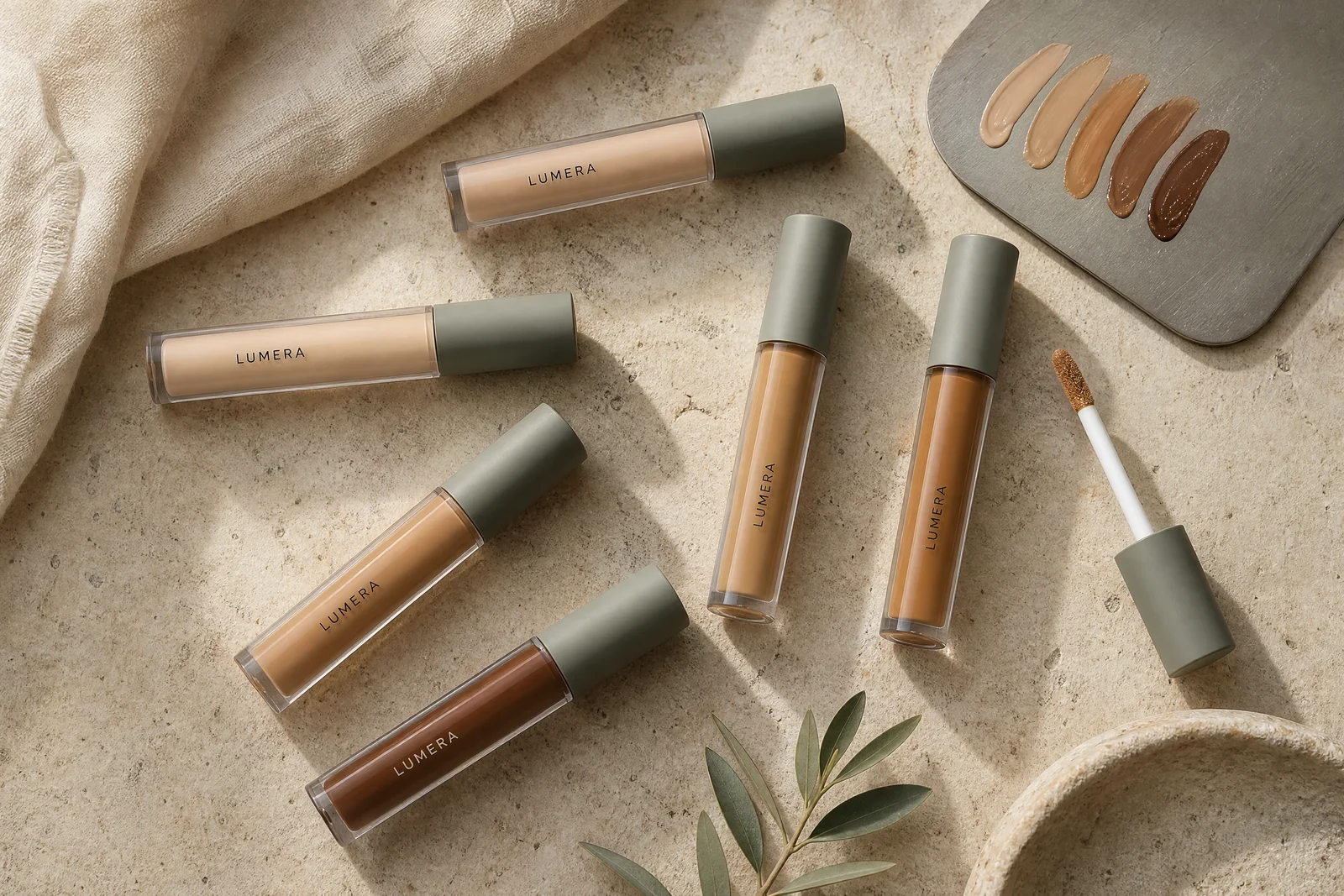
Concealer is most useful when it has a specific assignment. That might be a little more coverage around the nose, a softened shadow under the eye or a small spot that still shows through a sheer base. One flexible formula often does more than several products chosen only for a trending finish.
Choose texture by placement
The under-eye area usually benefits from a formula that stays flexible. Very dry, matte products can make fine lines look more obvious when they are layered heavily. A spot concealer can be a little more concentrated, because it has a smaller area to cover and needs to stay put.
Let texture decide the tool too. A tiny brush makes it easier to keep coverage where you placed it; a fingertip can melt the edge into skin. The goal is not a perfectly hidden mark. It is an edge that is hard to notice at normal conversation distance.
Keep the shade logic simple
For spots and redness, begin with a shade close to the surrounding skin. Under the eye, some people prefer a slightly warmer or brighter shade, but a large jump in depth can make the area look gray or visibly highlighted.
Color correctors can be useful when discoloration is pronounced, yet they are not a required layer. If you use one, apply the thinnest possible veil and cover it with a matching concealer. A corrector that remains visible under the final layer is usually a sign that there is too much product.
Make a small test routine
Try a formula on a normal day, not only under a store mirror. Check it after the commute, after lunch and in indirect daylight. If it breaks apart, first reduce the amount and simplify the layers below it before deciding the formula is a complete mismatch.
Stop using any cosmetic that repeatedly irritates the skin. Product labels and ingredient lists are useful reference points, but they cannot predict every individual reaction.
PRACTICAL NEXT STEP
Keep the technique proportionate
Color cosmetics are easier to enjoy when the product has one assignment. A small adjustment to coverage, color or hold often looks more intentional than trying to correct every detail at once.
Use this article to guide: concealer, dark circles, redness.
- Apply the thinnest useful layer, then step back before adding more.
- Check shade and texture in daylight as well as under indoor light.
- Clean tools regularly and stop using a product that repeatedly causes discomfort.
Before making a purchase or adding another step, decide what this change would replace. A smaller, clearer test is easier to evaluate than several new products used at once.
Revisit the decision after a few ordinary uses. Keep what is genuinely useful, simplify what is not, and let comfort and practicality carry more weight than a trend or a single swatch.
Keep the limit clear: A cosmetic can change a finish, not diagnose or treat a skin concern. Keep products out of the eyes and follow the label directions.
EXPLORE THE CONTEXT
Continue through the beauty archive.
Take the next useful route rather than treating one article as the end of the question.
Sources
- U.S. Food and Drug Administration - Cosmetics Labeling Guide
- U.S. Food and Drug Administration - Color Additives
Last reviewed Sep 19, 2025. This article is educational and does not replace medical advice.